This will encourage exports and discourage non-essential imports such as precious metals

The Reserve Bank has taken some steps to shore up the domestic currency.

'We are not producing good students who are examining issues independently of what they are being fed either by the media or their educators,' says Aakar Patel.

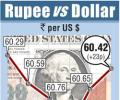
The rupee recovered by 11 paise to trade at 60.84 against the US dollar in early trade today on selling of the American currency by banks and exporters.
The dollar's gains against other currencies overseas and a lower opening in the domestic equity market also put pressure on the local unit, forex dealers said.

As we say shalom to 2016, the key drivers for the markets in the year ahead have become more obvious, says Neeraj Gambhir, managing director and head of fixed income, India, Nomura. First, there is a surging dollar. Second, rising commodity prices. Then, we have the effects of demonetisation.

Risk sentiment is likely to be favourable if oil prices stay benign, global growth sentiment remains robust and the dollar index does not break out, says B Prasanna.

World champion Nico Rosberg's retirement announcement on Friday came as a complete surprise even to the man who knows most of Formula One's best-kept secrets, commercial supremo Bernie Ecclestone.

The broader markets are trading inline with the larger peers with BSE Midcap and Smallcap indices up 1.5% each.

The dogs, who are fed regularly by the CRPF personnel, continued to bark, giving the personnel an idea that there were people hiding in a particular area.

Global private equity major KKR has ranked India second among the emerging markets on external risks, citing the high fiscal and current account deficits.
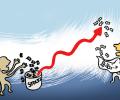
So far in 2019, India has been one of the highest recipients of foreign flows among Asian and Emerging Market (EM) economies
.jpg)
The newly-appointed Governor Raghuram Rajan said on Wednesday Reserve Bank of India will offer a window to banks to swap the fresh FCNR-B dollar funds, mobilised for a minimum tenor of three years and over, at a fixed rate of 3.5 per cent per annum. According to Bank of America Merrill Lynch, "the move should fetch $8-10 billion", adding that the move would help in shifting rupee risks away from NRIs at a time of extreme volatility.

The US Federal Reserve on Wednesday night hiked interest rates by 0.25%.

With the two latest resignations, 16 MLAs -- 13 from the Congress and 3 from the JD-S -- have quit while two Independent MLAs -- H Nagesh and R Shanker -- have already withdrawn support.

Brent crude prices fell to $57 a barrel on Monday from $62 a barrel.

RBI has, since January, cut its policy rate four times.

Indian equities are in a multi-year bull story with capex cycle recovery as the main driver.

If indeed we want the board to manage the RBI, probably the government should take a close look at the US Federal Reserve system which has a two-part structure - a central authority in Washington, DC, and a decentralised network of 12 Federal Reserve Banks located throughout the country, says Tamal Bandyopadhyay.

The flows may stem and redemptions pressure increase following the market meltdown of Monday amid mounting cases of coronavirus infection globally.

Rajan also said it's a problem of collective action and not a problem of industrial nations or emerging markets

India's gross domestic product growth rate slipped to 7%.
Investor wealth on Thursday soared by Rs 1 lakh crore, triggered by heavy buying in the stock market, with the BSE benchmark Sensex surging about 382 points to close at near six-week high levels.
As the economy teeters between bad and worse, one question looms: What's the best course of action? Here's what can be done. And what can't
RBI has reiterated its faith in the Indian economy but it has also put forth some key concerns that have the potential to derail the growth engine.
Interest rates still aren't low enough to stimulate the U.S. economy. Washington needs to engender more inflation so "real" rates turn substantially negative

The rupee is stable, and a number other of measures have been taken to bring stability in the capital market, the FM said.
.jpg)
According to the global financial services major, the primary concern for the RBI at the moment has to be anchoring elevated inflation expectations and stabilising the currency, which could face renewed pressures if the Fed begins QE tapering this week, as widely expected.
Unprecedented as it is, this steep cut in the interest rates effected by the Fed has the potential to dynamite the US dollar, the US economy and, by extension, the global economy.
Index majors NTPC, BHEL, Reliance Reliance Energy, Reliance Communications and HDFC, DLF, TCS, SBI and Bajaj Auto have zoomed.

The S&P and Dow dipped the most in a day since September 28.

The rupee is likely to strengthen to 60-61 level by this fiscal-end on expectations of improvement in current account deficit (CAD) and higher inflows from overseas investors.

Sensex witnessed the biggest single day gain since May 2009 in absolute terms.

The rupee closed at Rs 66.21 in its last trading session.

Increased demand from oil importers for the American currency and a weak opening in the domestic stock market also put pressure on the rupee.

'If an investor is ready to stay put for the next five years, one can consider investing in mid- and small-cap funds, but through SIPs.'

RBI Governor Raghuram Rajan on February 2, left the key interest rate unchanged citing inflation.
In the latest large opinion poll, the opposition Bharatiya Janata Party and its allies were forecast to win a narrow majority in the 543-seat lower house of parliament, compared with previous surveys predicting that they would fall short.

The fuzziness of Trump's economic blueprint remains the biggest risk.
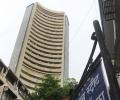
Investors will keenly watch US Fed meet starting Tuesday
